
Podcast: Play in new window | Download (Duration: 13:24 — 18.4MB)
Get new episodes by email RSS
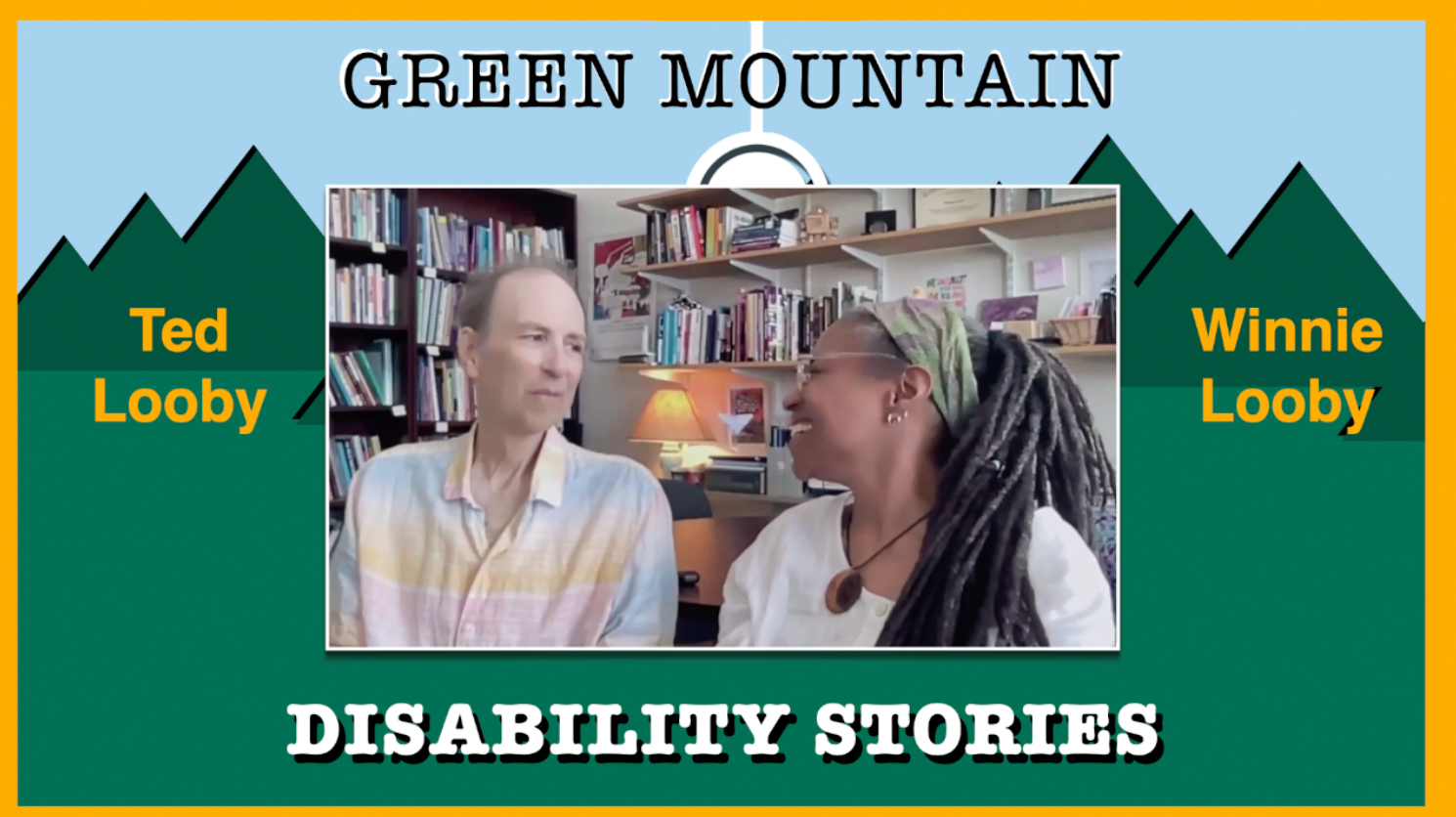
In this episode of Green Mountain Disability Stories, CDCI’s own Dr. Winnie Looby interviews her partner, Ted Looby. Ted Looby is a cancer survivor who is also blind, and he and Winnie talk about their favorite types of audiobooks, and what makes for a well-produced listening production.
This episode of Green Mountain Disability Stories was made possible by support from the UVM Office of Accessibility Services.
A full transcript appears below.
Winnie: Hello, I’m Winnie Looby. I’m with the Center on Disability and Community Inclusion and today I’m going to be interviewing Ted Looby, who’s also my partner. Could you please introduce yourself and tell us about your relationship with disability?
Ted: Sure. My name is Ted Looby. My relationship with disability probably started when we had kids actually and before that with Winnie and her health challenges. And then we had kids and we discovered they were on the autism spectrum. So we had to navigate the school system with them and the healthcare system with Winnie. And then with my own disabilities that popped up, well, I’ve had cancer twice. I had head and neck cancer. I had a part of my tongue removed. And then about six months later, I was diagnosed with central nervous system lymphoma, which is a fancy name for a brain tumor. And while I was undergoing treatment, I lost most of my vision. And so I had to adjust to that, not being able to do a lot of things I could do before but it also opened up other things to do, like listening to audiobooks and navigating with my white cane.
I sometimes use a wheelchair because I had a really bad spinal infection at the end of last year and that kind of zapped most of my energy. So here I am.
Winnie: Yeah. So that actually ties to… Let me think. There’s a question about if you identify as a person with a disability.
Ted: I do, yes. Yeah, probably so.
Winnie: Yeah. So what would you say if somebody asked you your category of disability, what do you tell them?
Ted: Well, I identify as blind and I guess physically disabled too with my legs.
Winnie: Mobility.
Ted: Mobility, yes. That’s what I was looking for. Thank you.
Winnie: Okay.
Ted: So those two things. Yeah.
Winnie: So do you regularly use any kinds of assistive technology? You’re talking about, I guess, a wheelchair is assistive, right?
Ted: Yeah.
Winnie: White cane. What other kinds of stuff do you use?
Ted: I have an iPhone, which is really helpful.
Winnie: Oh, really?
Ted: There’s lots of accessible features on there. I like seeing AI, which can read instructions on how to cook something.
Winnie: Oh, like an app on your phone that you use? Cool.
Ted: Yeah.
Winnie: And you mentioned audiobooks.
Ted: Oh, yeah. I have this app called BARD, which is through the Vermont or the state of Vermont libraries. And so I can download books for free using ABLE Library. And so I’ve read so many books on there. I think those are the big things.
Winnie: Okay. Now we’re going to shift a little bit. Want to talk about audio described multimedia. So do you regularly consume audio described multimedia?
Ted: Like television or movies?
Winnie: Yeah.
Ted: Yeah. Yeah. I mean, some are great, like The Residence TV show with Uzo Aduba.
Winnie: Oh, it’d been on Orange is the New Black.
Ted: Yeah. That had a great audio descriptive feature.
Winnie: Yeah, that was good.
Ted: And it helped me understand what was going on with the show plot. And some are not so good, just really dry narrators.
Winnie: So like computer voices sometimes.
Ted: Yeah, it sounds like computer generated voices. So that’s the difficulty. And was it who has audio descriptive for Netflix?
Winnie: It just depends on what the piece of media is. I don’t know why. It’s not consistent. So some specific shows or movies will have it available and others won’t. And like when you watch on YouTube and sometimes things are captioned really well, sometimes they’re not captioned at all.
Ted: Oh, yeah.
Winnie: Yeah, similar.
Ted: Yeah.
Winnie: So it’s kind of like you can’t really depend on it to be consistent.
Ted: That’s true.
Winnie: So you were talking about when it worked really well for this one particular show we watched.
Ted: Yeah.
Winnie: Right. So how do you find good audio-described media?
Ted: I think you have to know who the narrators are. I have my favorite narrators on Audiobooks, so that helps a lot. I listened to this Zora Neale Hurston book and Ruby Dee narrated it and it was like she set the bar so high, it was hard to go back to other narrators. But there’s definitely people that I check and just see what else they narrated so I can listen to those books.
Winnie: I see. So you look for a particular person that’s going to read it to pick a book?
Ted: Yeah.
Winnie: Oh, nice.
Ted: I know.
Winnie: That’s a good idea. That’s a really good idea. Well, can you talk a little bit more about when it doesn’t work as well as you’d like it to work?
Ted: Yeah, it’s not engaging. It’s hard to engage with the story. If someone sounds like a robot or it is a robot or AI, I have a hard time getting through a book when it’s like that.
Winnie: Have you liked to stop the book and switch to something else–
Ted: Oh, yeah.
Winnie: … if it’s bad? Okay.
Ted: Definitely. Yeah.
Winnie: Because it takes how many hours would you say it takes to get the book?
Ted: It depends on the book. Some are 25 hours long of listening and others are like five or 10 hours.
Winnie: Yeah.
Ted: And the books that are engaging, they could be 20 or 30 hours and it just flies by.
Winnie: Nice.
Ted: And I look forward to listening to it. I think Robin Miles is another narrator that I really like. And Dominic Hoffman is another one. So those two are great for me to listen to.
Winnie: Cool. So what would you say is the most satisfying thing about using audio-described media? You’re saying particular narrators. And is it kind of the dynamics of their voice, their interpretation of what’s happening?
Ted: Yeah. Yeah. Well, like with Ruby Dee, it was listening to her perform like a stage show.
Winnie: Nice. Yeah.
Ted: She would do all the voices and the descriptive of what was happening. That was really helpful.
Winnie: Yeah.
Ted: I get a little irritated when someone tries to do an accent that they can’t do.
Winnie: Oh, no, that’s bad.
Ted: Someone who was the American tried to do a Scottish accent and just turned out horrible and I had to put the book down. It didn’t work. But I think the performance is huge. The story is engaging. I’m trying to think what else.
Winnie: Oh, it seems like the way you describe it, it’s like a whole nother art form really.
Ted: Oh, yeah, definitely.
Winnie: Right?
Ted: Definitely. Yeah.
Winnie: Yeah. There’s the story that you would read on paper, but then another way to experience it. That’s kind of even richer really.
Ted: Yeah. So I can imagine in my head what people look like and what the place they live looks like.
Winnie: Nice.
Ted: So that’s also beneficial for me to use my imagination.
Winnie: That’s cool.
Ted: Yeah.
Winnie: Let’s see. So what’s one thing you wish more people knew about audio-described media?
Ted: That it’s an actual book. I’ve heard some people say it doesn’t count. That just kind of gets in my craw because it does count. It’s an accessibility feature that allows people who can’t see to enjoy books and magazines and any print media. So I wish they would understand more about that.
Winnie: I think it applies to… It’s beneficial for lots of people though too, right?
Ted: Oh, yeah.
Winnie: Like one of our kids really didn’t like reading, kind of had some trouble with it so they didn’t want to read and then we found them really good audiobooks and then that really got them going.
Ted: They let us. Right.
Winnie: They could engage in a different way.
Ted: That’s true. Yeah. Or people with dyslexia, I think, would be a great tool for them to listen to audiobooks. And as far as processing goes, I’m not the fastest processor anymore. So if I need to pause the book and kind of take in what I just listened to-
Winnie: You can do that.
Ted: … I can do that. It’s really helpful.
Winnie: Oh, nice. Nice. And then anything else that you wanted to say about just access in general, I guess?
Ted: I think the curb cuts are huge and the automatic doors are another thing. I mean, because if you go down to Church Street is most of them are not accessible because they have a little step-up and you can’t get into the wheelchair.
Winnie: Yeah. The doorways are kind of narrow.
Ted: Yeah, that’s the other thing.
Winnie: Yeah.
Ted: So if you have a wheelchair, kind of get jammed or your fingers get pinched. Yeah.
Winnie: That’s all right. Well, thanks for being willing to get interviewed.
Ted: Oh, you’re welcome.
Winnie: Yeah, not a super exciting interview, but hope it’s…
Ted: No, I had fun.
Winnie: Okay.
Ted: I had fun.
This episode of Green Mountain Disability Stories was made possible by support from the UVM Office of Accessibility Services. It was edited and produced by Audrey Homan. Learn more about digital accessibility at the University of Vermont by visiting go.uvm.edu/accessibility.