Toilet Training Methods: What’s the Difference?

When we guide a parent or guardian to start toilet training, our goal is successful and relatively smooth completion.
Resarch and experience generally divide readiness indicators into three domains:
You can skip to any section for bullet points, suggested talking points, and relevant resources. You can also tap the dropdown arrow for a detailed description and our recommendations on that topic.
When assessing a patient’s toilet training (TT) readiness, consider which skills are predictive of success versus those that are more correlative or helpful. For example, walking and simple imitation are develop many months before toilet training for most children. While they help the toilet training process, a child is not ready to TT just because they can do those things. A child who shows pride in accomplishments is more likely ready to undertake new and difficult skills (correlative). A child who is dry at regular intervals or predicts the need to go demonstrates objectively more physiologic control of continence (predictive). A child who shows more interest in the toilet may have more “buy-in” at first (predictive), but they may simply have had more exposure to the toilet, what it does, and why you use it.
On the VCP team, we remind parents that continence and toileting are not a single skill, but a collection of skills and knowledge that develop over time. Rome was not built in a day, and neither was a continent child! As you read the rest of this guide, ask yourself not only “what signs does this child have?” but “how likely are they to complete toilet training with relative ease?”
Statistically, a child who starts intensive toilet training before 27 months will not complete the toilet training any sooner than a child who starts after 27 months.
Blum et al., 2003
In other words, starting earlier doesn’t mean finishing earlier; it means toilet training for longer.
Parents need to hear in plain terms that their child can only respond to a sensation that she or he can feel. The VCP focuses extensively on the management of functional constipation because it is extremely common and contributes directly to the development of Bowel and Bladder Dysfunction.
Withholding patterns can arise from even a single instance of discomfort. A child who is hiding, straining, or posturing (clenching, tiptoes, lying in a rigid position, etc.) is not passing feces easily or completely. Furthermore, a child with a history of withholding in the absence of treatment has likely lost sensation of the need to stool, not resolved the withholding.
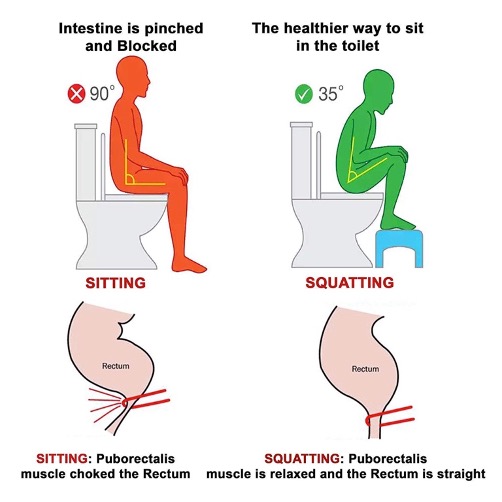
Advise parents that young children will physiologically gravitate toward a flexed, squatting, crouching position, and desire to complete a bowel movement. Other behaviors are strong indicators of withholding. Other positions also make TT much more difficult practically, as children have to retrain themselves to stool in a position different than their habit.
“Do you know what position your child is in when he/she poops? Does he ever hide? Does he seem like he’s trying not to poop? Did he ever do this in the past?”
Predictability reflects a colon that’s moving stool through on a normal rhythm, which is part of the physiologic groundwork for readiness. A “regular” child (e.g., stools after meals, once daily) is also easier to anticipate and coach than one whose pattern is erratic.
Asking a parent to complete a weeklong bowel record is a productive way for a parent to connect with their child’s elimination.
“Do you notice any pattern to when they poop? How often do you think they poop?”
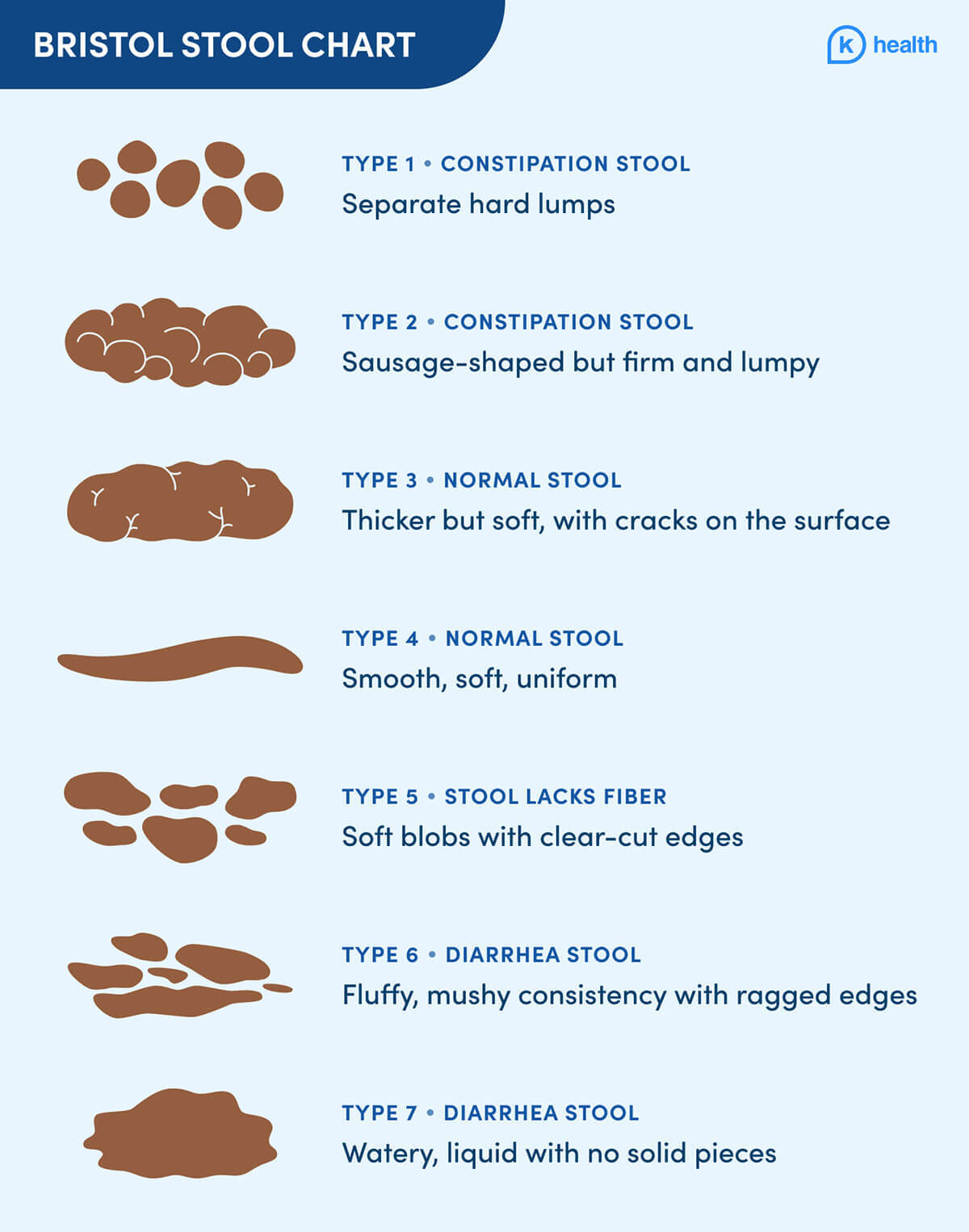
A child’s Bristol Stool Scale rating is a strong, but not ironclad, indicator of their constipation status. If a parent reports a child has a type one or two stool even semi-regularly, your suspicion of constipation should be strong. Softest stools, such as type six or seven, are also worth investigating as they are frequently overflow incontinence. Finally, patterns of mixed stool consistency are often indicators that a child regularly ignores the call to stool, leading to multiple bowel movements coming out at once (a harder, older stool combined with a newer, softer one).
“Does one of these pictures look like your child’s stool? Does it ever look like any other pictures, or look like something that’s not on this chart? Does he/she ever have poops that are a mix of different types?”
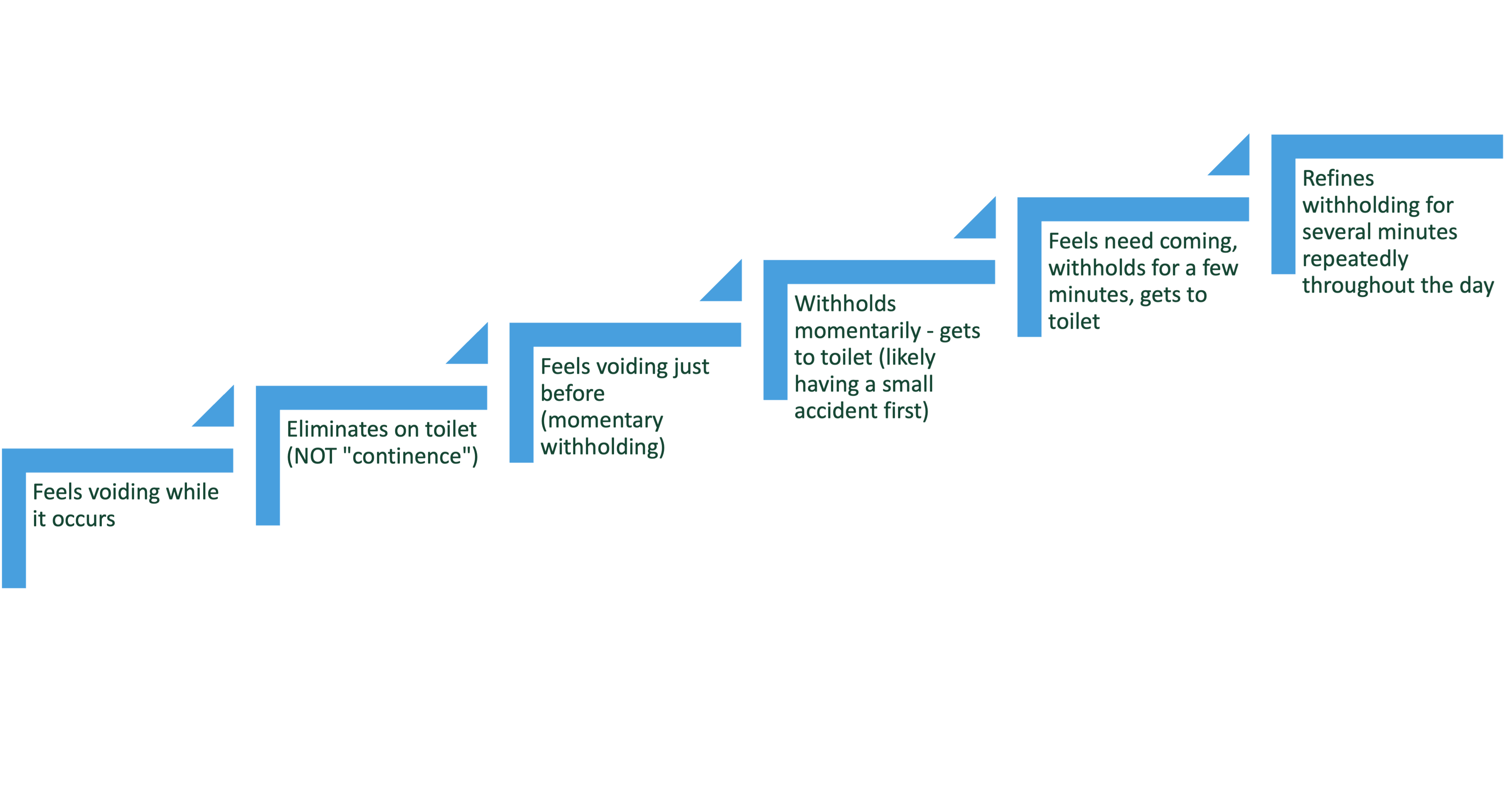
A child who pauses an activity to urinate or stool, grabs at their crotch, or announces they’re “going to go” before it happens is showing the earliest, most basic sign that they are registering bladder or bowel fullness as a distinct sensation.
A child who can hold on for even a short window after first feeling the urge is demonstrating the beginning of volitional control over the pelvic floor and external sphincter. This is a small window, but it’s the same neural circuitry that eventually stretches to minutes and then hours.
Noting urination or stooling when — or immediately before — it happens are great indicators of the transition to volitional continence.
“Do you have any sense of when he/she is about to pee or poop? Does your child give any indication that they know?”
A maturing bladder will develop capacity for stretch/inhibition while the sphincters engage, which consolidates the number of voids they have daily. A child who is wetting more often may not have matured sufficiently, or may be experiencing the bladder impacts of functional constipation.
It’s essential that a child’s dryness reflect bladder capacity and control, not dehydration or habitual withholding. A child who’s dry because they haven’t had much to drink, or because they’re stool-withholding and holding urine along with is not consolidating their voids.
Rather than dribbling or stopping and starting, urine comes out in one or two continuous streams. This reflects a coordinated relaxation of the sphincter alongside detrusor contraction—the muscles are working together instead of against each other. A child who struggles to urinate completely should be screened for Bowel Bladder Dysfunction. They may also be responding to an over-eager parent who is encouraging TT before the child is ready, causing them to try to withhold urine. This can eventually lead to paradoxical contraction, staccato urine stream, and lower urinary tract symptoms.
“Have you noticed what it sounds like when she/he pees in the toilet? Is it little drops, or does it sound like a smooth stream?”
A child who voids promptly once seated ( is showing you that the urge-to-void pathway is intact and that they can act on it voluntarily. A child who recognizes the urge but cannot release urine when sitting may need support for pelvic floor concerns. Conversely, a child who sits when prompted by a parent may not have the sensation yet.
“How long does it take for him/her to pee once sitting?”
These are skills that parents can see, and will often report as indicators their child is ready to TT. These skills that generally make TT easier (helpful skills), but you can also find accommodations when these skills are not aligned with the child’s physiologic readiness and interest
Can the child pull their own pants up and down? It’s often the rate-limiting step for independent toileting, as many children have the bladder awareness before they have the fine and gross motor coordination to manage waistbands in time.
Make sure the parents have considered what clothes they’ll use during early TT.
“How does he/she do with taking pants on and off?”
Toilet posture should be upright, still, and stable. A child ideally can maintain this position for 2–5 minutes if needed, since a lot of early successes take a few minutes to coordinate.
Counsel parents to purchase a small potty or seat reducer and step stool. Either is acceptable, as long as it supports the child’s body.
Can the child get to the toilet in time, and can they climb on and off independently (or with a step stool)? A child who needs to be carried to the bathroom or lifted onto the seat is dependent on an adult being present and attentive.
A child with strength, tone, or coordination concerns may benefit from a small potty that can be carried close to the child’s play area and be easier for the child to access independently.
Readiness isn’t only about what a child’s body can do—it’s about whether they want to do it, know how to do it, and have the executive functions to follow through. This is often the least tangible category for parents to assess, but it’s frequently the piece that determines whether training goes smoothly or turns into a battle of wills.
The VCP generally advises that parents and providers consider a child’s temperament and how this may affect their engagement in toileting.
A child who demonstrates a desire for mastery and to “get it right” may be more motivated through the inevitable early misses. Some children with a fiesty temperament may show a strong desire to do it “myself”; this is something to work with, not against!
“Would you say your child likes doing things independently? What’s something they’ve insisted on doing themselves lately?”
Toileting almost always interrupts something more fun. A child who can override their desire to keep playing is demonstrating cognitive flexibility and inhibition. TT also intersects with the “no phase” of toddlerhood, so transitions should be teased apart from how the child responds to prompts.
“How does your child respond when asked to switch from something more fun to something less fun?”
Can the child sit for 2–5 minutes without losing interest or leaving? Do they seem to notice bodily sensations, rather than being so absorbed in play that everything else fades into the background? Both reflect an attentional capacity that allows a child to act on physiologic readiness.
“Can he/she stay seated in one place for a few minutes at a time? How about if it’s a little boring?”
Toileting is, at its core, a sequence. While this capacity to plan and execute isn’t necessarily a must at the beginning of TT, a child who has this strength will move toward independence more quickly.
“Can your child follow a routine with a few steps, like ‘get your shoes and your coat from the mudroom’ —without you having to walk them through each part?”
When child has even a few readiness indicators, it’s not uncommon for a parent to want to jump to toilet training. After all, changing diapers for years is no one’s idea of fun.
In our experience, the best anticipatory guidance you can offer is how parents can recognize their child’s current developmental state and move toward their toilet training goal. We call this “wait and do”, rather than “wait and see”. The wait and do approach aligns beautifully with a child-led toilet training approach and the VCP’s concepts of holistic toileting readiness.
Use the language of “inchstones” to describe the smaller achievements that will pave the way for continence, and make sure parents know when to check back in. This empowers parents to understand the indicators of their child’s own readiness, beyond a list of bullet points.