The Three Domains of Readiness


This guide defines many of the major components of a toilet training program, how they may differ between rapid and child-led approaches, and VCP’s own recommendations, when appropriate. Most entries also include links to relevant resources
Children are more likely to develop lasting toileting skills when they feel like active participants rather than passive recipients of adult direction. Child-led approaches use components such as encouraging the child to choose their training potty, limiting use of prompts, and applying child interests to toilet training, such as TT books or videos featuring favorite cartoon characters. We also suggest that children receive developmentally appropriate information about elimination and toileting to place them in the driver’s seat of their toilet training journey.
Small changes to the environment can make toileting easier and more successful. Parents should know that proper positioning — including foot support and a stable sitting surface — is not an afterthought: it’s central to helping a child relax his/her pelvic floor muscles to empty the bladder and bowel more quickly, easily, and effectively.
Other modifications include putting the potty in close proximity to the child, decreasing environmental stimuli, and keeping bathroom routines predictable. Environmental supports are emphasized in both rapid and child-led approaches because they reduce barriers to success rather than relying solely on behavior.
Using the toilet involves many separate skills beyond simply recognizing the need to go. Children must learn clothing management, hygiene, self-initiation, and more to complete the toileting routine independently. Rapid toilet training teaches these skills directly and intensively, often through repeated practice.
Child-led approaches also teach these skills but usually introduce them gradually through modeling, practice, and everyday routines before expecting independent toileting. Parents can start this process gradually by reading books, observing family members, discussing body signals, practicing hygiene and clothing management, and moving diaper changes into the bathroom.
We recommend a slower approach to pre-teaching, as it can decrease the shock experienced by more sensitive or reactive children when they are asked to change several skills at once.
Adequate hydration supports healthy bladder and bowel function regardless of the toilet training approach. A well-hydrated child will have more experiences of bladder distention and release, providing clear sensations that children can learn to recognize. Fluids also help keep stools soft, reducing the risk of constipation, which is a common barrier to successful toilet training. In rapid toilet training, increased fluid intake may be used temporarily to create more frequent opportunities for successful toileting. In child-led approaches, the emphasis is on maintaining age-appropriate daily hydration rather than intentionally increasing voiding frequency.
Parents may have heard that they should increase their child’s intake of dietary fiber. However, counsel parents that adequate hydration must come before the addition of dietary fiber, and in a proportion of approximately 3:1 (fluid:fiber) by weight. Parents can track their child’s fluid and fiber intake to determine whether they are balanced.
Prompting includes verbal reminders, visual cues, schedules, timers, or other supports that tell children to attempt toileting. Rapid toilet training relies on frequent adult prompting, often paired with densely scheduled sits. Child-led approaches typically use fewer prompts and encourage children to recognize and act on their own body signals.
For some children, prompts may be an important bridge from what the parent sees (wiggling, clenching, etc.) to a child beginning to recognize and respond to sensation. However, parents over-use of prompts is a notably frequent source of conflict between parent and child, and stands in the way of the true goal, toileting. The VCP generally suggests using the lowest level and intensity of prompting possible. We also suggest using prompts that enable the child to stay in the driver’s seat and experience natural consequences. For example, if a parent sees a child moving in a way that indicates that they may have to “go”, the parent can simply say, “it looks like your body is giving you a signal,” and then go back to what they are doing. This removes the direct command associated with telling the child to use the toilet. The child may choose — or not — to go, but they have experienced the relationship between the sensation, naming that sensation, and the outcome.
For most children, maintain the goal of self-initiation, beginning the toileting routine without prompting. Recognize that self-initiation requires a great many skills: 1. Identification of sensation in a timely way; 2. Assigning meaning to that sensation; 3. Executive function skills adequate to transition between activities; 4. Adaptive skills to manage clothing; 5. Adequate pelvic floor integrity; and 6. Knowledge of expectations. Help parents to scaffold the place where the difficulty is occurring, rather than prompting or expecting all steps.
Regardless of approach, prompts should gradually fade as children become more independent.
Reinforcement brings attention to a specific skill or behavior that the child demonstrates by creating a positive association with that behavior. The intention is to increase the frequency or consistency with which the child demonstrates that behavior. Rapid toilet training often uses immediate, highly motivating reinforcement (such as small toys or food) for successful toileting behaviors. Child-led approaches typically emphasize praise, encouragement, and the child’s intrinsic satisfaction while using external rewards more selectively.
Encourage parents to positively reinforce the small steps (what the VCP calls “inchstones“), especially when the child is showing signs of stress, slow progress, or the parent-child dyad is in conflict. Inchstones give the child boosts of success, and help the parent see the progress that the child is making, rather than what isn’t working. Caregivers can reinforce any aspect of toileting (such as wiping, self-initiation, or even hydration), not only elimination-in-toilet. Regardless of the approach, reinforcement is generally most effective when it targets specific, achievable behaviors rather than perfection.
Parents also need support to think about what makes a good reward, and how to give it. Toileting is an activity learned by frequent repetition over several days, even weeks. If the parent chooses a reinforcer that’s expensive, hard to give, won’t happen for a long time, or doesn’t interest the child, it won’t make clear the parent’s intention. Counsel parents on 1. the inchstone/behavior to emphasize, 2. the type of reward to give, and 3. their reinforcement schedule.
The original rapid toilet training protocol included corrective procedures such as overcorrection, a behavioral procedure where a child repeatedly practices parts of the correct toileting routine after an accident. While historically part of rapid toilet training, overcorrection is not included in child-led approaches and is generally discouraged in contemporary developmental and trauma-informed practice because it may increase stress without addressing underlying physiologic readiness.
Child-led approaches recommend calm, neutral responses that focus on helping the child clean up and move forward without shame or punishment.
Children are generally very attuned to their parents hopes around toileting, and they may start to hide or deny when they have wet or soiled, rather than face their parent’s disappointment. These children are sometimes branded as “stubborn” or even “liars”. Parents should be reminded that the child is most likely trying to avoid upsetting or disappointing them.
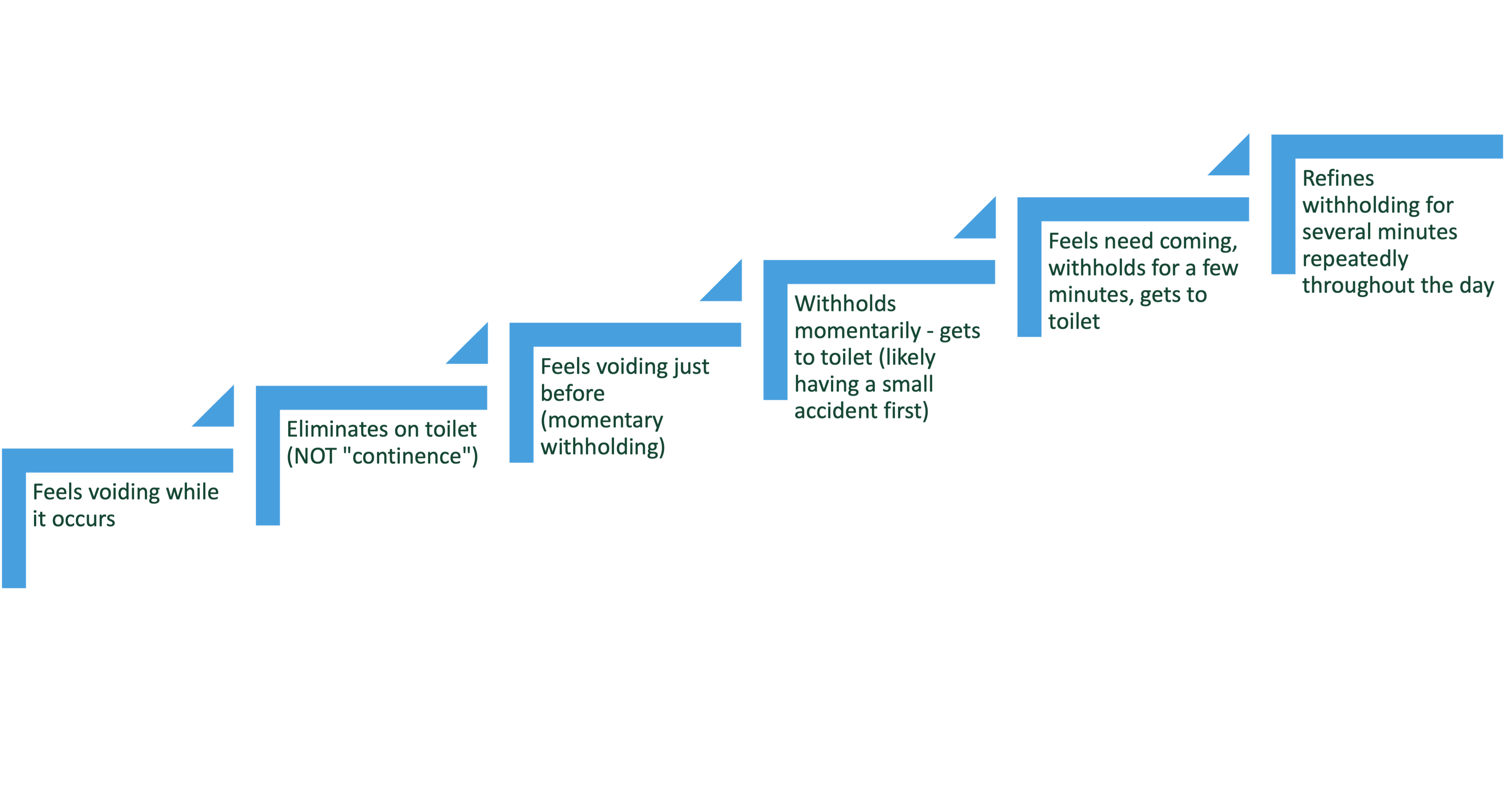
Other children may start to withhold indiscriminately. Parents may at first see this as progress (dry pants), and the lack of actual toileting does not become apparent until later. When children are having trouble with toileting, PCPs should be sure to ask not only how often they are having accidents, but how often they are going at all.
Scheduled toilet sits provide regular opportunities for children to practice using the toilet, particularly during times when elimination is most likely, such as after meals. Rapid toilet training often uses dense schedules with sits every 15–30 minutes during intensive training. Child-led approaches generally recommend fewer, routine-based opportunities integrated into the child’s day. Scheduled sits can increase opportunities for success but may decrease self-initiation. They should gradually become less frequent as children begin initiating toileting independently.
Rapid toilet training typically introduces underwear early in the training process to maximize learning opportunities. Child-led approaches often wait until the child demonstrates readiness and interest.
Transitioning from diapers or pull-ups to underwear increases children’s awareness of wetness and can strengthen the connection between body sensations and toileting. However, underwear, applied too early cannot “jumpstart” physiologic readiness, and is more likely to cause withholding than true continence. If parents would like to try underwear/no diapers, we suggest they try for two or three days at home, and observe whether there is a trend toward fewer accidents and more self-initiation. If a child does not show a change over a few days, the parent may want to pause the underwear, and should be counseled that this is not a demonstrated failure on their part, or their child’s.
Although underwear can promote awareness, families should also anticipate more accidents during the transition and provide calm, supportive responses. Gauge the caregiver’s Distress Tolerance; how will they feel if the child urinates or stools on the floor? Do they have coping tools, and a sense of when they’ve had “enough” for now?
It is also normal and appropriate that a child is less successful at toileting or staying dry or clean in environments other than their home. Parents can continue to use pull-ups or diapers when they are out and about until the child is reliably dry and clean for much of the day.